
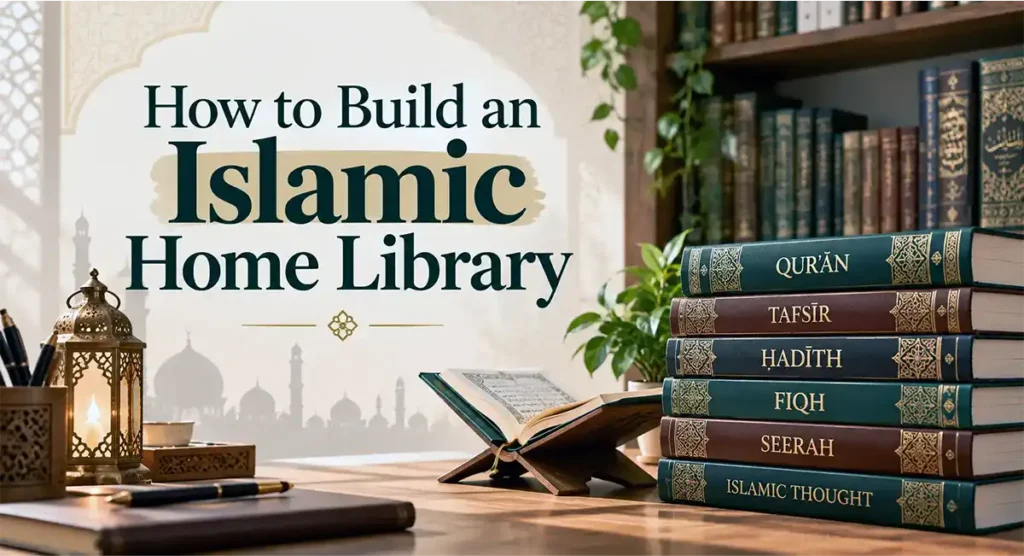
A good Islamic home library does not need to contain hundreds of books from the beginning. A smaller collection selected according to the needs of the family can often be more useful than a large library that lacks structure.
A practical starting point is the Holy Qur’an. Alongside the Arabic text, families may keep a reliable translation in the language they understand best. Urdu readers may choose an Urdu translation, while English-speaking family members can benefit from an English translation with explanatory notes.
The next level is Tafsir. While a translation provides the basic meaning of Qur’anic verses, Tafsir gives readers greater explanation and context. Comprehensive works such as Ma’ariful Qur’an can therefore serve as long-term reference material for a family library.
A balanced Islamic library should eventually extend beyond Qur’anic studies. Collections relating to Hadith, Fiqh and Fatawa, Seerah, Islamic history and Arabic studies allow readers to explore different branches of Islamic knowledge.
Families with children should also maintain a separate selection of age-appropriate Islamic books. Developing familiarity with Islamic literature at a young age can make books a natural part of family learning.
Another useful category is contemporary Islamic literature. Modern life creates questions relating to employment, trade, banking, financial transactions and social matters. Scholarly works dealing specifically with contemporary issues can help readers understand how traditional Islamic principles relate to modern situations.
When buying books for a home library, attention should also be paid to language, binding, book size and whether a publication is a single volume or a complete multi-volume set. A reference Tafsir may remain on a bookshelf for many years, so a durable edition can be preferable, while a smaller book may be more convenient for daily reading.
The best home library is ultimately one that is actually used. Begin with essential books, organize them by subject, and gradually expand the collection according to the interests and study needs of the family.
Maktaba Darul Uloom is being developed around this same principle: making Islamic books easier to discover by category, author, publisher, language and format, so readers can build a useful collection rather than simply purchasing individual titles.