
Islamic finance has developed into an important part of the modern financial system, offering Muslims an alternative to conventional interest-based banking. At the heart of Islamic banking is the principle that financial transactions should comply with the teachings of Shariah and avoid prohibited elements such as Riba (interest), excessive uncertainty, and impermissible commercial activities.
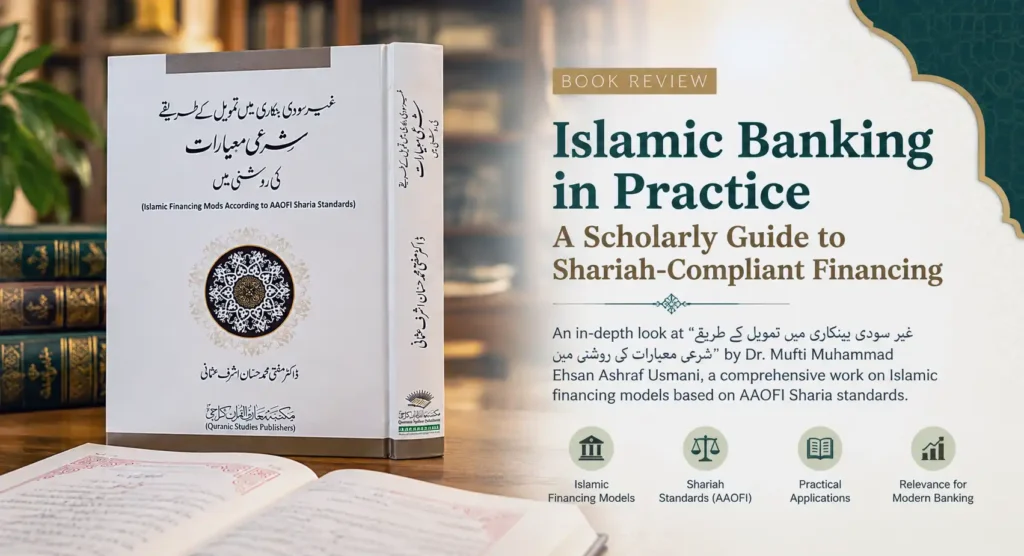
The Urdu book “Ghair Soodi Bankari Mein Tamweel Ke Tareeqay – Shariah Mayarat Ki Roshni Mein” by Dr. Mufti Muhammad Imran Ashraf Usmani addresses this important subject by discussing methods of financing in non-interest-based banking in the light of Shariah standards. The book is published by Quranic Studies Publishers.
Its English subtitle identifies the central subject as Islamic financing modes according to AAOIFI Shariah Standards, making the work particularly relevant to students, Islamic finance professionals, scholars, bankers, and readers seeking to understand how contemporary banking can operate within an Islamic legal framework.
Why Islamic Banking Is Different
Conventional banking frequently uses lending arrangements in which money is advanced in return for a predetermined interest payment. Islamic finance approaches financing differently.
Instead of treating money itself as a commodity that generates a guaranteed return, Islamic financing generally connects financial activity with genuine trade, assets, services, investment, or partnership.
This distinction is important because Islamic banking is not simply conventional banking with different terminology. Its contracts, ownership responsibilities, risks, rights, and obligations must satisfy Islamic commercial principles.
A transaction may therefore need to be structured around an actual sale, lease, partnership, or other permissible arrangement rather than an interest-bearing loan.
The Importance of Shariah Standards
Modern financial transactions can be highly complex. Banks, businesses, and customers may encounter situations that did not exist in their present form in earlier centuries.
For this reason, clearly defined Shariah standards play an important role in contemporary Islamic finance. They help financial institutions understand how traditional Islamic commercial principles may be applied to modern banking products.
AAOIFI — the Accounting and Auditing Organization for Islamic Financial Institutions — is widely known in the Islamic finance sector for developing standards dealing with Shariah, accounting, governance, auditing, and related areas.
The book’s focus on financing methods in light of such Shariah standards helps connect classical Islamic jurisprudence with the practical requirements of contemporary financial institutions.
Common Modes of Islamic Financing
In Islamic finance generally, several contractual structures are commonly used to provide financing without conventional interest.
Murabaha is a cost-plus sale arrangement in which an institution purchases an asset and then sells it to the customer at an agreed profit margin. The sale price and profit are disclosed and agreed upon in advance.
Ijarah is a leasing arrangement. Instead of lending money at interest for the purchase of an asset, an Islamic financial institution may acquire the asset and lease its use to the customer according to agreed terms.
Musharakah is based on partnership. Two or more parties contribute capital to a venture and share profit according to an agreed ratio, while losses are generally linked to their capital participation.
Mudarabah is another partnership-based structure in which one party provides capital while another provides management or expertise. Profit is distributed according to an agreed arrangement, subject to the principles governing the contract.
Salam involves advance payment for specified goods that will be delivered at a future date. It has particular relevance to certain agricultural and commercial transactions.
Istisna is frequently associated with manufacturing, construction, or production contracts in which an asset is produced according to agreed specifications.
These structures illustrate an important feature of Islamic finance: financial return is normally associated with legitimate commercial activity, ownership, risk, service, or investment rather than the mere passage of time on a monetary loan.
More Than the Elimination of Interest
A common misunderstanding is that Islamic banking is concerned only with removing interest from financial transactions.
In reality, Shariah-compliant finance involves a broader ethical and legal framework.
Contracts should be transparent. The subject matter of a transaction should be permissible. Rights and responsibilities should be clearly understood. Fraud, deception, unjust enrichment, and excessive contractual uncertainty are matters of concern.
This means that the validity of an Islamic financing product depends not only on its name but also on how the transaction is actually structured and executed.
A transaction labelled “Murabaha,” for example, must satisfy the relevant requirements of a genuine Murabaha transaction. Merely replacing conventional financial terminology with Islamic terminology does not automatically make a financial arrangement Shariah-compliant.
Relevance for Modern Islamic Banking
As Islamic banking expands globally, the need for knowledgeable professionals and well-informed customers also increases.
Bankers need to understand the Shariah basis of the products they offer. Business owners need to know the nature of the financing agreements they enter into. Students of Islamic economics require exposure to both classical jurisprudence and contemporary banking practices.
Books dealing specifically with financing modes and Shariah standards therefore provide an important bridge between traditional scholarship and modern financial practice.
“Ghair Soodi Bankari Mein Tamweel Ke Tareeqay” is particularly relevant in this context because its subject focuses directly on the mechanisms through which financing can be structured without conventional interest.
Who Can Benefit from This Book?
The book can be useful for students studying Islamic economics and finance, bankers working in Islamic financial institutions, Shariah scholars dealing with contemporary financial questions, researchers, business professionals, and general readers interested in understanding how an interest-free financial system operates.
For readers who encounter technical Islamic banking terminology but want to understand its underlying Shariah principles, a work of this nature can also serve as an important reference.
Conclusion
Islamic banking seeks to establish financial relationships based on lawful trade, investment, partnership, asset ownership, transparency, and ethical responsibility while avoiding interest-based transactions prohibited by Shariah.
Understanding the correct financing mechanisms is therefore essential for the successful operation of an Islamic financial system.
“Ghair Soodi Bankari Mein Tamweel Ke Tareeqay – Shariah Mayarat Ki Roshni Mein” by Dr. Mufti Muhammad Imran Ashraf Usmani addresses this important field by examining non-interest-based financing within the framework of Shariah standards.
For readers interested in Islamic banking, contemporary Fiqh, Islamic economics, and Shariah-compliant finance, the book represents a useful addition to their study and reference collection.
Leave a Reply